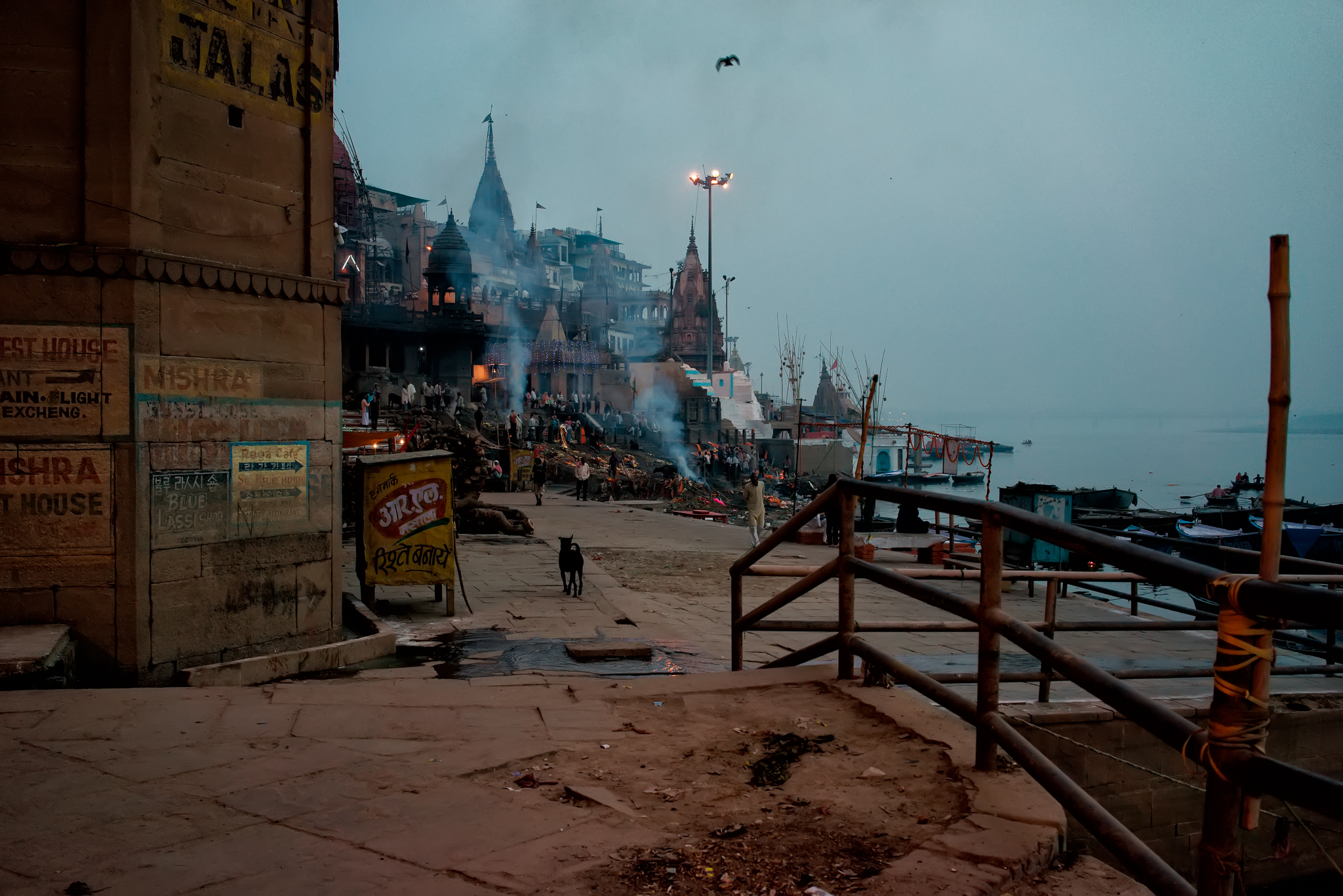
There is something in this portrait, captured in the ancient labyrinth of Varanasi’s ghats, that stops me mid-thought—the way certain faces do when they carry within them the weight of worlds abandoned and worlds being born. This young woman, a monk who has traded whatever Western life she once knew for the ochre robes and endless questions of the spiritual seeker, holds in her gaze that particular quality I have come to recognize in fellow travelers. Yet hers is not the restless hunger of those still seeking, nor is it the peaceful settlement of those who have found. Instead, there is something more complex—the tremulous awareness of someone suspended between surrender and loss, between awakening and the persistent ache of what was left behind.
Her nose ring catches the light with an intimacy that speaks of adoption rather than inheritance—chosen heritage rather than given birthright. This delicate gold ornament, so carefully placed, represents something more complex than tradition; it is the conscious embrace of a culture not born into but walked toward, step by deliberate step. I wonder about the moment she first wore it, whether it felt like coming home or like playing dress-up in someone else’s spiritual vocabulary. In this small circle of metal, I see the paradox that has haunted my own travels: how we can journey so far from home only to discover that what we seek has been carried within us all along—or perhaps, how sometimes we must become strangers to ourselves before we can recognize who we truly are.
But it is her eyes that compel me to linger in this moment of recognition. They hold that rare quality of presence, but it is presence sharpened by absence—the awareness of someone who knows intimately what it means to leave everything behind. There is something both ancient and raw in that gaze, as if she inhabits multiple temporalities at once: the monk she is becoming, the woman she was in some Western city whose name she may no longer speak aloud, and perhaps most hauntingly, the space between these identities where transformation occurs not as gentle evolution but as daily choosing.
I find myself wondering about her before—was she someone who wore tailored suits to board meetings, who worried about mortgage payments and career trajectories? Did she have a name that her colleagues called across office corridors, a voice that participated in conference calls bridging time zones she now marks only by meditation hours? The questions feel both intrusive and necessary, because in her face I see the cost of spiritual seeking that my own comfortable travels have never demanded.
Only years later, walking through Trastevere’s ochre-washed walls and terracotta rooftops, would I recognize these same colors echoing in my memory of Varanasi’s amber stones and saffron-draped temples—as if certain hues carry the same spiritual frequencies across continents, revealing themselves to us only when we are ready to see the connections. There was something in that Roman light, filtering through narrow medieval streets, that made me understand retrospectively what I had witnessed in the illumination that falls across the ghats, the way sacred cities seem to hold light differently, more intentionally. I remember the old woman arranging flowers at the shrine of Santa Maria in Trastevere, her weathered hands placing each bloom with the devotion of someone who understood that some prayers are spoken through gesture rather than words. These are the moments when we touch something beyond the reach of guidebooks and GPS coordinates, when we discover that the most significant distances are not geographical but ontological.
I have stood in the Louvre before the Mona Lisa and felt the peculiar magnetism of a painted gaze that seems to follow the observer, but this photograph carries a different power entirely. Here is someone who appears to be looking not at the camera but through it, past it, toward something the rest of us spend lifetimes trying to glimpse. It reminds me of what I wrote about seeking that elusive inner journey—that moment when we recognize in another’s eyes the very destination we have been walking toward without knowing its name.
The soft focus of everything beyond her face suggests that the photographer—that I—understood something essential about this particular form of portraiture: that to capture someone in the midst of such radical transformation requires the courage to let everything else fall away. The blurred edges of her robes, the gentle dissolution of Varanasi’s ancient stones into warmth and light—these are not merely technical choices but acknowledgments that to truly perceive someone who has chosen to dissolve their old life, we must first learn to see past our own assumptions about what it means to belong somewhere.
There is a stillness in this image, but it is not the stillness of peace. It is the stillness of someone learning to breathe underwater, of someone discovering that spiritual awakening might not feel like coming home so much as learning to be homeless in increasingly profound ways. She has come to this most sacred of cities, where death and rebirth play out daily along the ghats, where the Ganga carries away what people no longer wish to carry, and yet something in her expression suggests that the hardest letting go happens not in ritual but in the thousand small moments of daily choosing to remain a stranger to who you used to be.
This stillness speaks to what I have been circling around in my own reflections about inward travel. It is the stillness of someone who has perhaps discovered what I am still learning: that the journey to the soul does not require us to abandon the world entirely, but rather to inhabit it so fully, so presently, that the boundaries between inner and outer begin to dissolve.
The young woman in this photograph seems to embody that recognition. There is no urgency in her expression, no reaching toward something absent. Instead, there is the profound simplicity of someone who has begun to understand that the Self we seek is not a destination to be reached but a presence to be acknowledged—not through the accumulation of experiences, but through the patient work of attention, of learning to see what has always been there.
Perhaps this is what draws me so powerfully to her gaze: the suggestion that she has found, or is finding, what I have been seeking through all my wandering. Not the mystical dissolution of the self, but its quiet affirmation—the recognition that to know who we are, we must first learn to be where we are, fully and without reservation.
In her eyes, I see reflected the truth that has been emerging slowly through my own travels: that the journey inward and the journey outward are not separate expeditions but different expressions of the same fundamental human impulse toward discovery. And sometimes, if we are very fortunate, we encounter another traveler whose presence reminds us that we are not walking this path alone.