The water refuses stillness today.
Where two days ago the lake held the mountains in perfect reverence, today it speaks—small waves catching light, fracturing it into a thousand conversations between blue and white, between what is and what reflects. We walk along the shore, searching for something we’ve lost: our reflection. But the ripples have taken it, dissolved it into movement, and perhaps this is more honest. Perhaps we were never meant to see ourselves in perfect clarity, frozen in a single image. Perhaps we were always meant to be this—motion, change, the subtle disturbance that proves we are here.
She bends to touch the water, and I watch her fingers break the surface. The cold makes her gasp, that quick intake of breath I’ve heard in so many contexts over the decades—surprise, delight, the small shocks that punctuate a life lived together. Her hand emerges wet and gleaming, and she shakes it in the air, laughing, unchanged. Not physically—we both carry the evidence of years in ways we don’t discuss—but in this capacity for joy, this ability to be completely present in a moment that asks nothing but attention.
“It’s freezing,” she says, as if the information itself is a gift she must share.
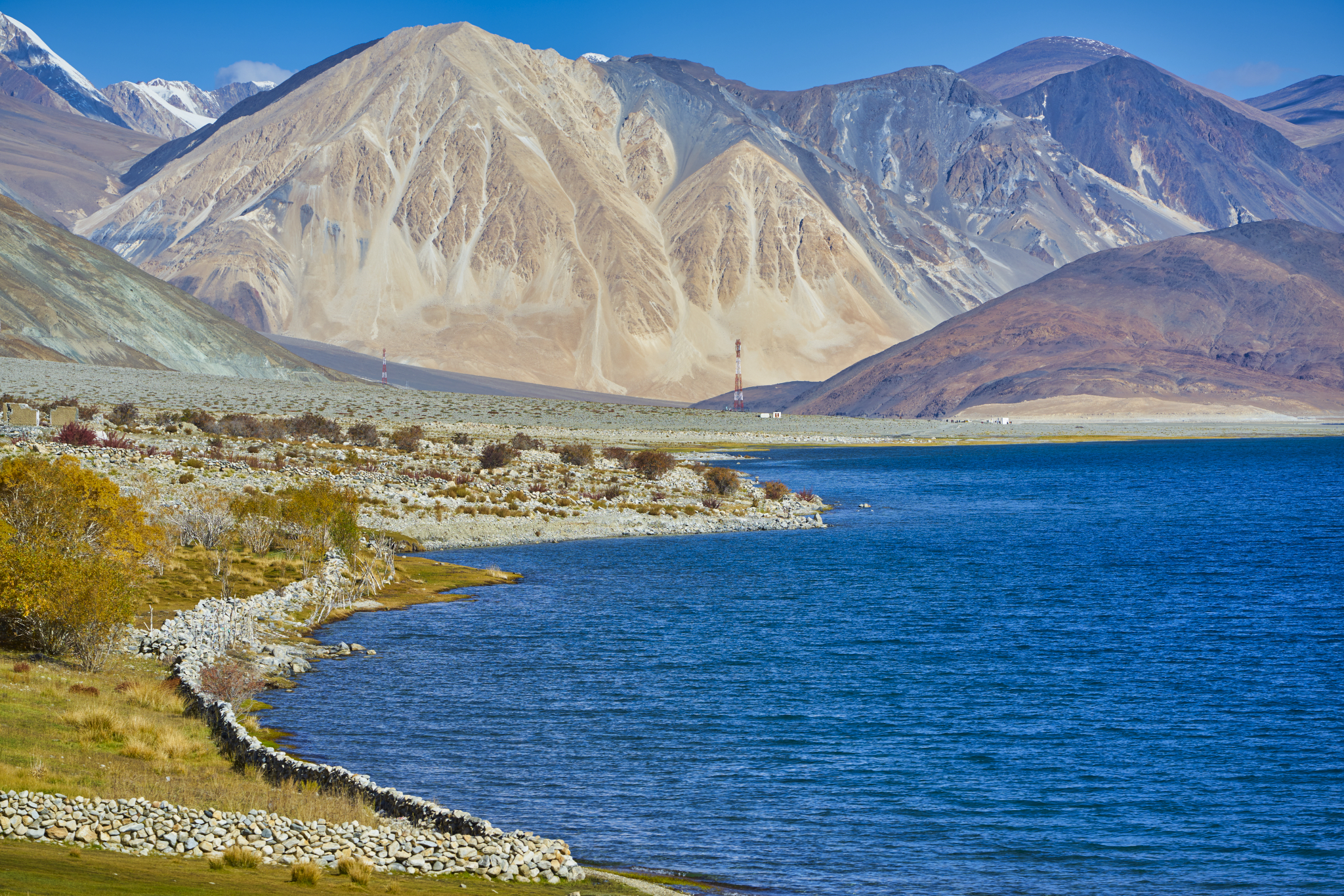
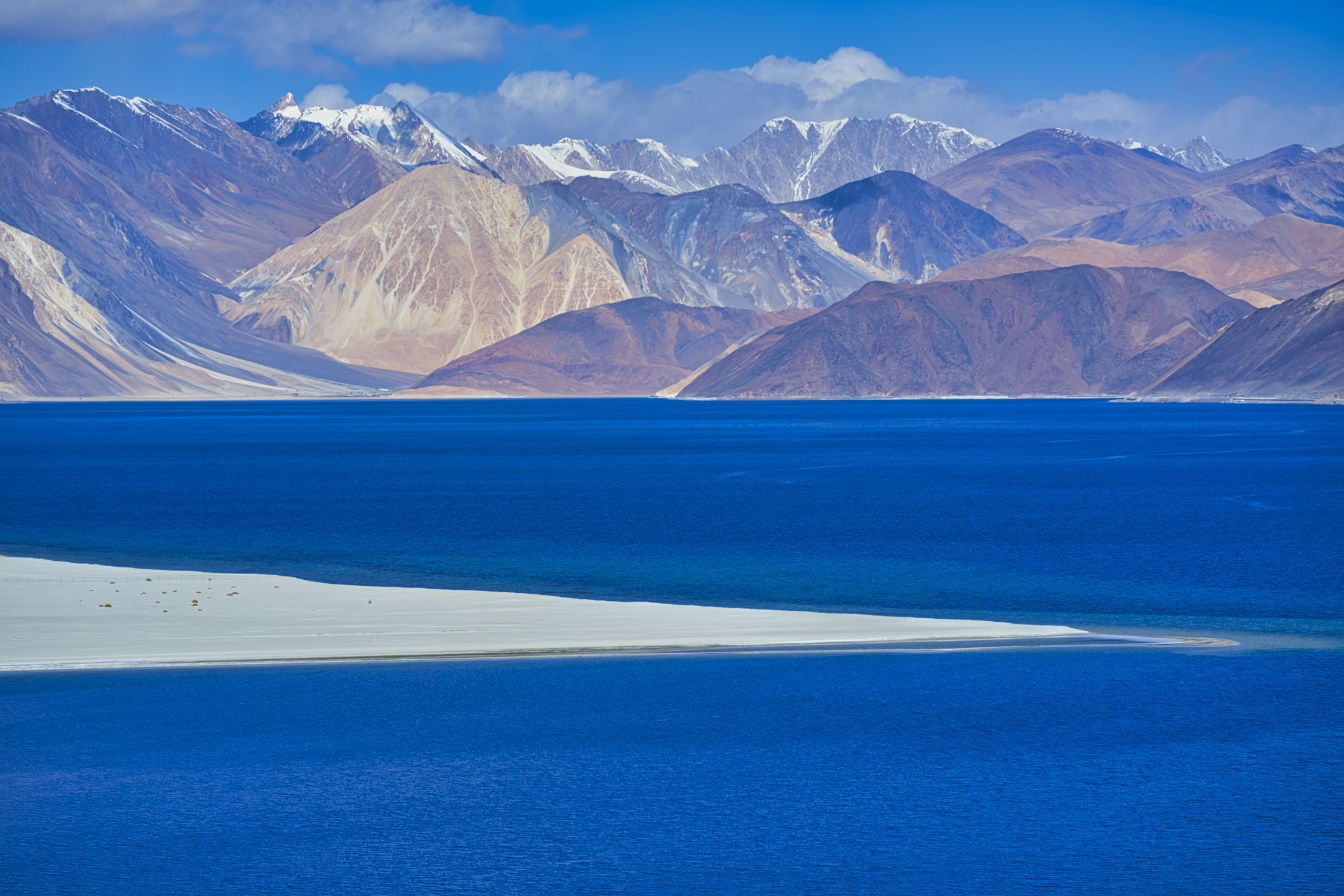
The mountains rise around us in their geologic patience, tan and purple and rust, their slopes etched with lines that might be erosion or might be the records of time itself. Snow clings to the highest peaks, stubborn against the impossible blue of the sky. A communications tower stands in the middle distance, and somehow it doesn’t disturb the landscape. It simply exists, as we exist, brief and witnessed.
The wind comes steady off the water, carrying a cold that finds every gap in our layers. It pushes against our faces, this wind that has traveled across the lake from some distant shore we cannot see. The air tastes thin and mineral, the altitude making each breath something you notice. I think of all the places wind has found us—on beaches and mountaintops, in cities where we didn’t speak the language, in quiet moments on our balcony at home. Wind is democratic in its attention. It touches everything with the same intimate indifference.
“Do you remember Gurudongmar?” she asks.
That other lake, that first journey together when everything was possible and nothing was certain. Gurudongmar was still then—a mirror of pure possibility. We had looked into that mirror and thought we saw our future.
“This is different,” I say, gesturing at the restless water.
“Everything is different,” she agrees, smiling.
She means it both ways—everything has changed, and that is precisely what makes this moment precious. We are not the people who stood at Gurudongmar’s shore, and that’s not a loss. That’s accumulation. That’s decades compressed into something irreducible.
Movement catches my eye—ducks, a small group of them, swimming near the shore with that peculiar economy of effort waterfowl possess. They glide across the rippled surface as if the water’s restlessness doesn’t apply to them, leaving V-shaped wakes that intersect and dissolve. It’s the photographer in me that notices first, that constant scanning for the detail that tells a larger story.
“Look,” I say, pointing.
She follows my gaze and her face lights up in that way I’ve learned to watch for—the way joy arrives for her, sudden and complete. “Oh! They’re so calm. Everything’s moving except them.”
We stand watching the ducks navigate their world with an assurance we can only approximate. They belong here in a way we don’t, and yet they make space for our witnessing. One dips its head beneath the surface, then emerges, water streaming off its feathers, and she laughs softly at the simple fact of it.
We walk on, our feet finding purchase on the rocky shore, stones shifting slightly under our weight with small clicking sounds, past scrub vegetation that survives despite everything, past stones bleached white by sun and water. And then she stops, a small sound of surprise escaping her.
“Wait,” she says, stepping backward, then forward again. “Feel this.”
I move to where she’s standing, and my foot sinks slightly into the ground—not dangerously, but enough to notice. The shore here is different, softer somehow, the earth giving way beneath our weight like something alive and breathing. She bounces slightly, testing it, and her face transforms: pure wonder, uncomplicated delight.
“It’s like walking on a cushion,” she laughs, taking careful steps in a small circle, watching her feet sink and rise. “How is it doing this?”
I don’t know if it’s wet sand beneath a dry crust, or some particular combination of soil and moisture, and it doesn’t matter. What matters is watching her discover it, this small anomaly in the landscape, this unexpected softness in a place of stones and hardness. She’s someone who has lived long enough to know that most ground is solid, that most things resist us, and yet she still looks for the exception, still lets herself be surprised.
“Be careful,” I say, because that’s my role, but she’s already moved on, testing the ground ahead with each step, narrating her findings.
“Here it’s soft. Here it’s not. Here again—yes!”
The lake stretches before us, and yet it feels like it was arranged just for this—for us to walk its edge, for us to remember, for her to find soft ground in an unexpected place and show me that wonder is not something youth owns exclusively. It’s something you choose, again and again, even when the world has given you every reason to walk carefully, to expect hardness, to protect yourself from surprise.
She takes my hand, and her fingers are cold from the water, but I don’t let go.
“I can’t see us,” she says, looking down at the rippled surface. “I can’t see our reflection.”
I turn to look at her then, really look at her—the lines at the corners of her eyes that map laughter and worry in equal measure, the way the wind catches her hair, the slight flush on her cheeks from the altitude and the cold. Her eyes meet mine, and there it is. There we are. Not the reflection we’ve lost to the ripples, but something truer—the accumulated weight of every glance exchanged across breakfast tables and hospital waiting rooms and moments exactly like this one.
“We’re here,” I tell her.
She squeezes my hand, understanding everything I’m not saying, everything I’m saying badly.
The lake continues its conversations with itself, wave after small wave lapping against the shore with a sound like whispered secrets, and the mountains hold their positions with the patience of geological time. The sun is warm despite the cold wind, and somewhere a bird calls—harsh and lonely and perfectly suited to this landscape. We are so small here, two figures on an endless shore, and yet we contain multitudes. We contain all the years, all the versions of ourselves we’ve been, all the moments that led to this one.
She hasn’t lost it—that essential quality, that ability to be broken by life and still rise the next morning looking for beauty, still bend to touch cold water just to know what it feels like, still find wonder in ducks swimming and ground that gives way softly beneath your feet. Some people harden with time, calcify their disappointments into armor. She has remained somehow permeable, vulnerable, open to the world’s sharp edges and soft touches alike.
We have shaped each other like water shapes stone—slowly, persistently, with a patience that compounds into transformation.
Earlier, we had set up the small tripod, the camera perched on it like a mechanical bird, the timer ticking down our ten seconds to arrange ourselves. We’d positioned it carefully, framing the lake and mountains behind us, then rushed into place, laughing at our own urgency, trying to look natural while knowing we had only seconds. The shutter clicked. We checked the screen together, our heads close, and her reaction was immediate.
“This is it,” she’d said, her voice carrying that particular satisfaction that comes from getting exactly what you wanted. “This is exactly it.”
And I knew what she meant—not just that the composition worked, or that we were both in focus, but that somehow the photograph had captured this: us, here, together, with the lake and mountains bearing witness. That it held something true about this moment, this day, this life. Her joy was palpable, radiating outward, and I felt it too—that small triumph of making something lasting from something fleeting.
“Should we go back?” she asks eventually, though neither of us moves.
“In a minute,” I say.
We stand there, hand in hand, looking out at water that refuses to be still, at mountains that have watched this view for longer than humans have had words for it. The wind continues its work of reminding us we are alive—that we feel cold, that we feel each other, that we feel.
“Okay,” she says finally, pulling me back to the present. “Now we can go back.”
But we linger still, just a moment more, because we both know that this—this exact configuration of light and wind and feeling—will never happen again. The lake will be here tomorrow, and we might even return to its shores someday, but this moment, this precise arrangement of memory and present, of who we were and who we’ve become, exists only now.
And then we turn, together, and begin walking back along the shore, our footprints in the rocky soil the only evidence we were here at all, and even these the wind is already claiming, grain by grain, breath by breath, returning us to the landscape we borrowed for an afternoon.