The road from Rezang La stretched empty ahead of us. Not abandoned—just vast. The kind of emptiness that comes from space asserting itself over human presence.
We were heading to Hanle. The dark sky reserve. A place built for looking up, for seeing stars the way they were meant to be seen—without interference, without light pollution, just sky and darkness and the scattered brightness of everything that’s far away.
My wife and I sat quiet in the back. Our driver navigated the curves without comment, the way someone drives a road they know by reflex rather than attention. The memorial was behind us now. Miles behind. But I was carrying it with me. The names. The wind. The understanding that this road existed because someone had fought to keep it open.
Sand and Snow
The mountains changed as we drove. Snow-capped peaks gave way to closer ridges, then rose again in the distance. What struck me was the sand. Great sweeps of it climbing the lower slopes, golden and fine, meeting the snow line where white began.
Sand and snow on the same mountain. Desert and winter occupying the same space.
I’d never seen that before. The contradiction of it. Dry and frozen. Heat and cold. All at once.
My wife pointed. “Look at that peak.”
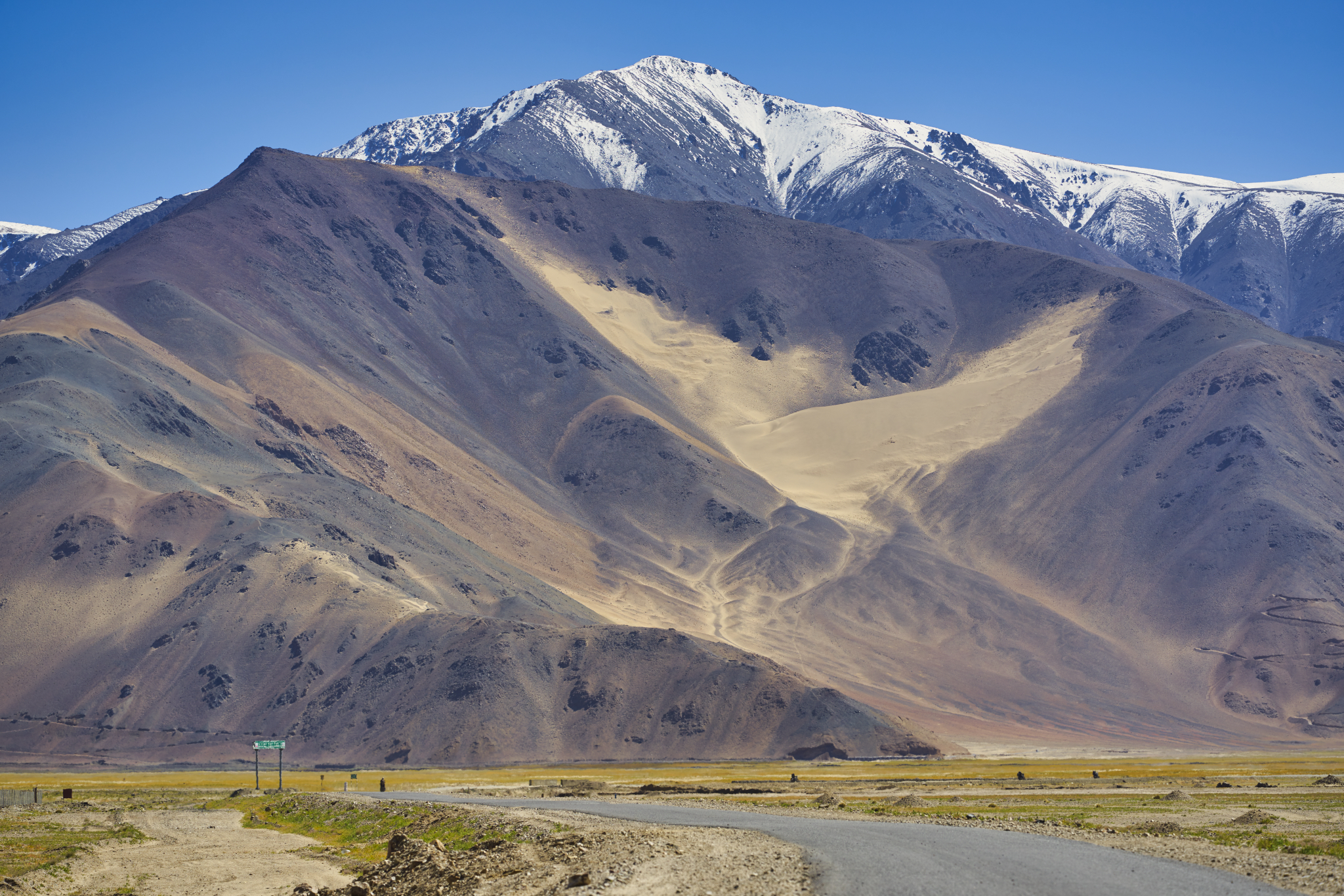
I looked. A mountain layered in bands—rock at the base, sand swept halfway up its face, snow crowning the summit. Three different worlds stacked vertically. As if the mountain couldn’t decide what it wanted to be, so became everything at once.
We watched in silence. The landscape performing its impossibilities. Mountains that held both drought and blizzard. Valleys where sparse vegetation somehow persisted despite altitude that should have made life impossible. Roads that cut through terrain so remote it felt like discovery even though we were following asphalt someone else had poured.
The road curved around the base of a mountain. On my side of the car, the slope rose steep and layered—rock, then sand, then snow. On my wife’s side, the land fell away into a valley where patches of green interrupted the brown. Life against lifelessness. Both true. Both present.
What Memory Does
My thoughts drifted to my grandmother. Not deliberately—just the way thoughts drift when there’s nothing to anchor them. When landscape scrolls past and mind follows.
She used to tell me that people became stars when they died. The night sky was full of everyone who’d ever lived, watching, waiting, lighting the dark for those still walking below.
She’d told me the story on a night when I’d asked where my grandfather had gone. He’d died when I was six. Old enough to understand death as permanent but young enough to need it to be something else.
“He’s up there,” she’d said, pointing at the sky. “That bright one. See it? That’s him. Watching you. Making sure you’re okay.”
I’d looked for that star every night for months. Convinced I could feel my grandfather’s presence in its light.
Now, driving toward Hanle—toward a place specifically designed for seeing stars—I thought about her story again. Not because I believed it. But because we were going to look at stars. And stars had my grandmother in them now. Her story. Her attempt to make death bearable for a frightened child.
The road straightened. Mountains in the distance. Sky so blue it looked artificial. My wife was looking out her window. I was looking out mine. We were together but separate. Each watching our own version of the landscape pass.
I thought about Rezang La. About the names on the wall. About how those men existed now only as plaques and photographs and stories told by people who weren’t there.
One hundred and fourteen men. If my grandmother was right, that was one hundred and fourteen new stars in the sky above this landscape.
I didn’t believe it. But I understood why she’d told me that story. Why every culture has some version of it. Because the alternative—that people just end, that sacrifice leaves nothing but absence—is too hard to carry.
The Empty Road
The road continued. Mountains on both sides. My mind kept drifting.

The mountains kept changing. Some pure rock, stripped to geological fundamentals. Others held snow in their highest reaches. Some had that sand, climbing their faces halfway before giving up. Each one different. Each one indifferent.
I thought about how we make constellations. Draw lines between stars that aren’t actually connected. Tell stories about patterns that only exist from our particular angle of observation.
My grandmother’s story was like that. A pattern imposed on randomness. A narrative constructed to make loss bearable.
A sign appeared, marking distance to Hanle. Not far now.
We’d arrive. We’d look up. We’d see stars. Thousands of them. Maybe millions. The Milky Way spread across darkness.
And I’d be thinking about my grandmother. About her trying to explain death to a six-year-old by turning it into stars. About how I’d never know if she believed her own story but I was grateful she told it anyway.
What Persists
The landscape became more barren as we climbed. Less vegetation. More rock. The altitude made breathing feel like work, even sitting still. We were at 15,000 feet and climbing higher.
Mountains persist through erosion, slowly wearing down but taking millennia to do it. Stars persist through fusion, burning for billions of years before exhausting themselves. Roads persist through maintenance, requiring constant repair but outlasting the people who build them.
But people persist differently. Not through our bodies, which fail. Not through our achievements, which fade. Through what we leave behind. Through memories held by others. Through names on walls. Through stories told by grandmothers to frightened children.
The road straightened. In the distance, I could see what might have been Hanle. A cluster of structures. A village. The observatory.
I thought about the soldiers at Rezang La. About how the sky above them that morning had been full of stars before the sun rose. The same constellations I’d be seeing at Hanle. Ursa Major. Orion. The Milky Way cutting across the darkness.
The stars had watched the Battle of Rezang La the way they’d watched everything before and everything since. Without judgment. Without intervention. Just persisting.
My grandmother would have said the soldiers became stars that night. It was a nice thought. Comforting in the way children’s stories are supposed to be comforting.
But the soldiers at Rezang La didn’t die to become stars. They died to hold a line. To keep a road open. They died for something immediate and concrete, not cosmic.
Still. I’d be looking at stars soon. And I’d be thinking about Rezang La. About one hundred and fourteen names on a wall. About memory and starlight—both ways we mark the absence of things that used to be present.
“Almost there,” our driver said.
My wife stirred. Looked ahead. Nodded.
The road carried us the last few miles in silence. Mountains on both sides. Sky deepening. The landscape performing its contradictions—sand and snow, life and emptiness, beauty and indifference.
Arrival
Hanle appeared gradually. Structures that seemed to have been placed carefully, as if the ground itself was precious.
We stopped. Got out. The air was so cold it hurt. The sky was the deepest blue I’d ever seen, even in daylight.
Tonight, we’d look up. We’d see what my grandmother had pointed to when she told me about transformation.
I thought about my grandfather, who’d died when I was six, who existed now only in memory. About my grandmother herself, gone now too, but still here in the story she’d told me. About the soldiers at Rezang La, who I’d never met but whose names I’d read.
About how all of them were still here in some way. Not as stars. But as echoes. As stories. As the shape their absence left in the world.
The sky would darken soon. The stars would appear. And I’d be there, looking up, carrying my grandmother’s story, carrying the names from Rezang La, carrying all the absences that had become presences through memory and time.
Ready to see what she’d tried to show me all those years ago.