There are places where you arrive and realize you have been traveling toward them your entire life without knowing it. The Hunder Dunes are not one of these places. They do not want you. They do not care whether you understand them. And this is precisely why, once you stand among them, you cannot leave—not physically, but in the deeper sense that matters. Something in you stays there, recording.
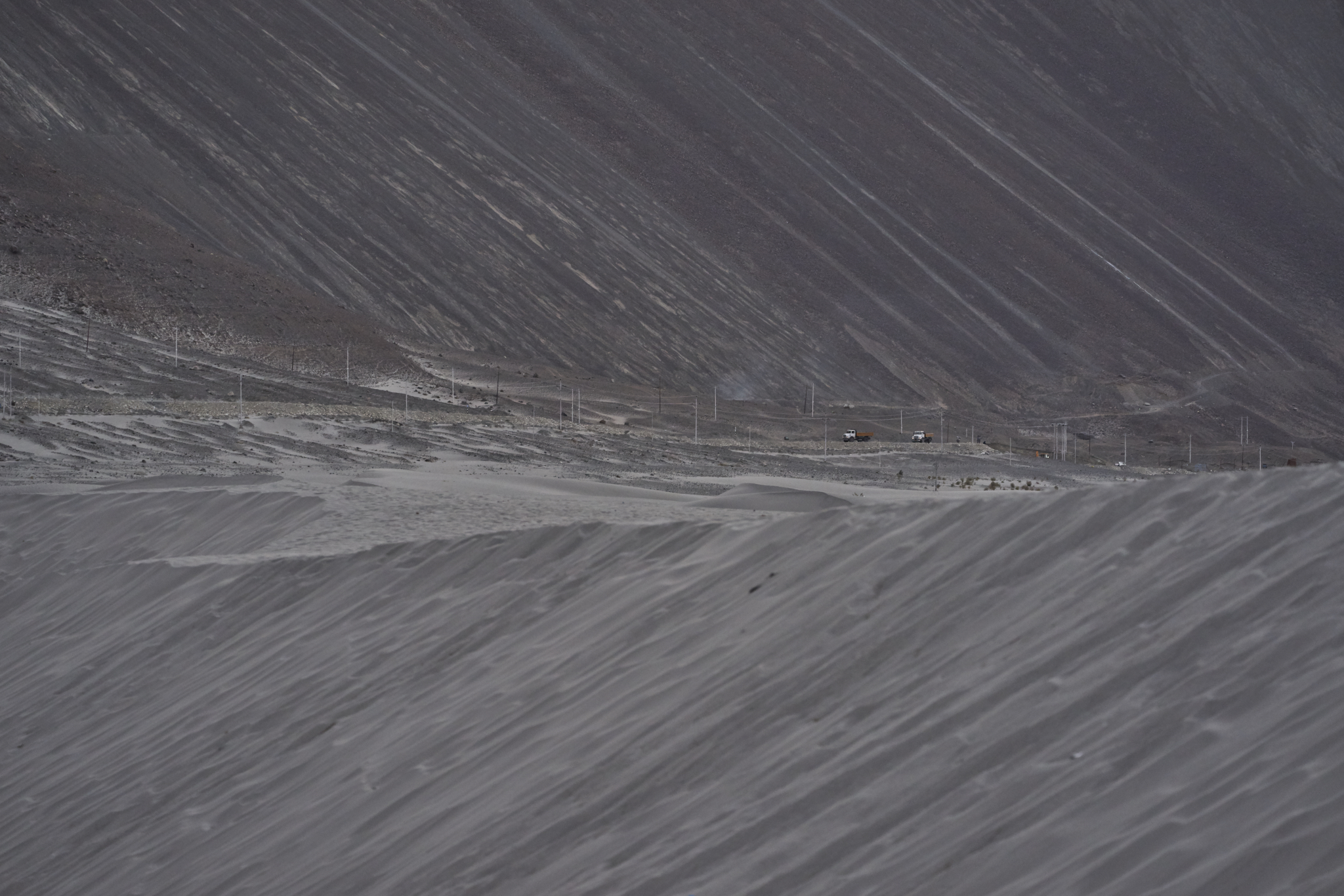
I stood on sand that shifts and mountains that do not, watching the boundary between them dissolve in the fading light. The photograph captured what was visible: the precise geometry of wind-carved ridges, the mountains behind them holding their form against shadow, the boundary between them impossible to determine. What it could not capture—what no photograph can—was the sensation of being shaped myself, the way the cold entered my chest and the silence entered my understanding, the way time, which had been chasing me for months, suddenly stopped.
Or rather: time did not stop. I stopped expecting it to move me anywhere.
The Two Permanences
We misunderstand what endures. We think permanence means staying the same, holding a fixed form against change. We look at mountains and think: there is something permanent. But the mountain is being worn away. Grain by grain, the wind takes it. The rock fractures. Water finds its way. The mountain is always in the process of becoming something else, and we simply cannot perceive the timescale.
The dunes, by contrast, seem impermanent. A gust of wind and the pattern shifts. Your footprints disappear within hours. The entire geography of a dune can transform in a season. And yet the Hunder Dunes have held their essential character for centuries. They are permanent precisely because they do not resist change. They accept it. They flow with it.
Perhaps this is the paradox that matters: the rigid thing breaks, and the fluid thing endures.
In the photograph, standing on that ridge and looking toward the mountains, I could not tell where one ended and the other began. The eye searched for the boundary and found only a continuum—sand becoming slope becoming peak, all of it carved by the same invisible forces working at different speeds. In that moment of visual confusion, something clarified. The dunes and mountains are not opposites. They are the same conversation in different dialects. Both are speaking the language of time.
What We Record, Not What We Create
Memory is a deceiving thing because it feels like retrieval. You think: I remember standing on those dunes. I am retrieving that moment. But you are not retrieving anything. You are standing in your present self, and the landscape you stood in is reaching forward through time to touch you again. It is not the same reaching. You are not the same self. What forms between them is neither the past nor the present but something that has learned to live in both.
This is why returning to a significant place fails and succeeds simultaneously. You expect the feeling to be waiting for you, unchanged, like an object you left on a shelf. Instead you discover that the feeling has continued to evolve in the part of yourself that carries it. You have changed. The place has changed—the light is different, the season has shifted, even the sand has remade itself. The meeting between your transformed self and the transformed place creates something new.
Not recovery. Renewal.
Here is what I could not have known standing on those dunes in that moment: that the emotion I felt was not something I was generating. I was recording it. The mountains, the cold that had crept into my bones, the particular quality of light—these were winds moving through me, and I was sand accepting their shape. The peace I felt was not an emotion I possessed but a pattern the landscape had written on me.
When I try now to recover that feeling by looking at photographs, by telling the story, by standing in memory on that ridge, I am not trying to retrieve what I felt. I am creating the conditions for the landscape to write itself on me again. The pattern will not be identical. My sand has shifted. The wind carries different dust. But something in the essential character persists—the same conversation between stillness and motion, the same indifference from the world and the same strange comfort it brings.
The Kindness of Being Unnecessary
In Nubra Valley, the landscape does not require your witness. The mountains do not benefit from your attention. The wind makes its patterns whether anyone is standing there to observe them or not. The sand will shift. The cold will gather in the low places. The light will leave. None of it hinges on you.
This should be crushing. It is not. It is the kindest thing the world could offer.
We spend our lives constructing narratives of indispensability. We arrange things so that our absence would matter, so that we are woven into outcomes. And the Hunder Dunes simply tell you: you are not necessary. The world will continue beautifully without you. And having heard this, you can finally rest.
When I stood on those dunes, I was peripheral to everything happening there. The mountains rose and held their form whether I was watching or not. My small figure meant nothing to the vastness. And in that insignificance I felt something like relief. Not because I had become important, but because I had finally stopped needing to be.
The photograph shows a small figure on sand, dwarfed by distance and stone. What it does not show is how that smallness felt like freedom.
The Dunes Write Themselves Into You
There is a way that significant places do not fade. They transform, but they do not disappear. They become part of the architecture of who you are. Not as a possession, not as a memory you can hold intact and protective, but as a fundamental alteration in how you understand scale, time, permanence, and what matters.
The Hunder Dunes have written themselves into me in ways I could not have anticipated. Not the facts about them—the geography, the history, the coordinates. But the feeling of standing on matter that shifts beneath your feet while observing matter that holds its shape for centuries. The understanding that both are real, both are true, and both are speaking the same language about impermanence and persistence.
When I try to explain this to others, language fails. I show them the photograph and they see sand and mountains and distance. What they cannot see is how the mind learns to hold two contradictory things as equally true: that nothing persists, and that something persists. That I am insignificant, and that I am here. That the moment has passed, and that I am still standing in it.
This is what the dunes teach, and it is not a lesson that can be unlearned.
Standing Where Two Infinities Meet
The moment comes to you quietly, not as a revelation but as a recognition. You are standing on sand, watching mountains, and you understand that you are being held by something that neither needs you nor excludes you. The indifference is complete. The embrace is total. These are not contradictions in this place. They are the same thing.
I stood on those dunes as the light began its leaving. The patterns in the sand were sharp and precise. The mountains behind me held their ancient geometry. Somewhere a wind was moving, reshaping everything it touched, and nothing was being lost because nothing here tries to resist.
In the days since, I have tried to recover that moment. I looked at the photograph. I told the story to people who listened politely and did not understand. I tried to recreate the precise temperature, the exact quality of silence, the particular way the light was failing.
And I failed. The moment had moved into the past. Time had done what time does.
But here is what I discovered: I had not lost it. It had been incorporated. The dunes had written themselves into my permanent geometry. The understanding I found there—that I am both necessary and unnecessary, both enduring and impermanent, both small and somehow still here—this understanding does not fade. It continues. It evolves. It becomes part of how I move through the world.
The landscape did not remember me. But I remember the landscape. And in that asymmetry—a place receives your presence without caring, you receive the place’s presence forever—truth emerges.
The dunes shift beneath your feet. The mountains hold their shape. Both are teaching the same lesson: that nothing stays, and that something in the essential character persists through all transformation. That you are here, briefly, and that this brevity is enough. That the moment you are losing to time is not being erased so much as it is becoming part of who you will be.
Stand long enough on sand that moves while watching stone that endures, and you will understand what the valley has been trying to tell you all along: that these are not two different things. They are the same thing learning to speak in different languages.
And you are already becoming it.