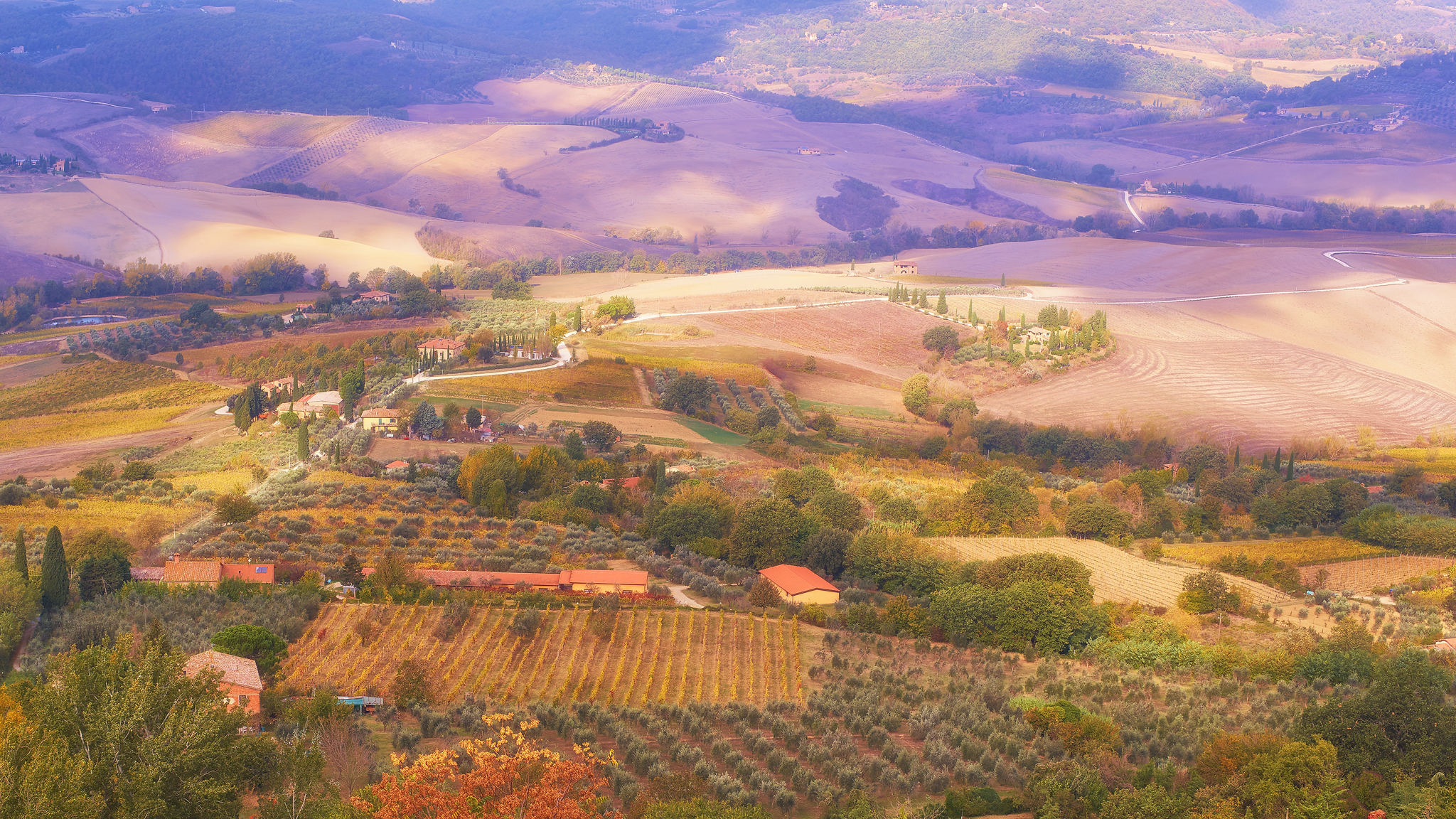
There are places on earth that seem to exist outside the ordinary flow of time, where the light itself carries the weight of centuries and the landscape holds conversations with eternity. Val d’Orcia is such a place—a valley in Tuscany where the rolling hills unfold like the pages of an ancient manuscript, each contour inscribed with stories that predate memory yet feel intimately familiar.
Standing here at dawn, watching the mist lift from these golden fields, I am reminded of how certain landscapes become repositories of longing. The cypress trees stand in perfect formation along the ridgelines, dark sentinels against the amber sky, and I think of all the travelers who have paused at this very spot, feeling the same inexplicable pull toward something they cannot name. Perhaps it is the way the morning light transforms the ordinary into the sacred, or how the gentle undulation of the hills seems to mirror the rhythm of breathing itself.
The farmhouses scattered across this pastoral canvas appear almost apologetic in their beauty, their terracotta roofs and honey-colored walls emerging from the earth as if they had grown there naturally. Each one tells a story of rootedness, of families who have tended these olive groves and vineyards through generations of plenty and scarcity, joy and sorrow. There is something deeply moving about this continuity, this quiet persistence in the face of time’s relentless passage.
Here in Val d’Orcia, a deep reverence for the land seems woven into the very fabric of existence. The vines climb their stakes with purposeful grace, the wheat fields shimmer like scattered gold coins, and everywhere there is evidence of the ancient contract between human and earth.
The photographer in me wants to capture this moment, to freeze the play of shadow and light across these undulating fields, but I know that some experiences resist preservation. They exist only in the present tense, in the space between heartbeats, in the pause before wonder transforms into words. The camera can record the surfaces—the way the morning sun sets the landscape ablaze, how the distant mountains fade into layers of blue and purple—but it cannot hold the weight of contemplation that settles over you here like a benediction.
There is a particular quality to Italian light that seems to understand melancholy, not as sadness but as a deeper recognition of beauty’s transience. It illuminates without harsh judgment, revealing the imperfections that make perfection possible: the weathered barn that has survived countless storms, the ancient oak whose gnarled branches speak of decades weathered in solitude, the simple chapel whose bell tower pierces the sky with quiet authority.
As the day progresses and the light shifts from gold to amber to rose, I am struck by how this landscape seems to exist in a state of perpetual becoming. Nothing here feels finished or final; everything is part of an ongoing conversation between past and future, tradition and change. The modern world feels both very far away and immediately present—in the gentle hum of a distant tractor, in the wine that will eventually emerge from these very grapes, in the photographs that travelers like myself will carry home like pressed flowers between the pages of memory.
Perhaps this is what draws us to places like Val d’Orcia: the promise that beauty endures, that there are still corners of the world where time moves differently, where the essential rhythms of life remain audible beneath the noise of our daily concerns. Here, surrounded by these rolling hills and ancient settlements, we remember what it means to be human in the most fundamental sense—to be creatures capable of recognizing beauty, of feeling gratitude for light and landscape, of understanding that some moments are worth preserving not in photographs but in the deeper archive of the heart.
The shadows are lengthening now, and soon the golden hour will give way to the blue hour, when the landscape will wear yet another expression of its infinite beauty. But I will carry this morning with me—the way the light fell across the wheat fields, the distant sound of church bells marking the passage of time, the profound sense of being present in a place where every sunrise feels like both a beginning and a remembrance.
In the end, perhaps that is what travel offers us: not just new sights to see, but new ways of seeing, new capacities for wonder. Val d’Orcia teaches us that beauty is not merely decoration but a form of truth, a reminder that the world still holds spaces of grace for those willing to slow down long enough to receive them.