I’ve stood in storms before. Not always literal ones, but I know the feeling—that moment when everything becomes opaque, when the path forward disappears, when all you can do is wait for the world to become visible again. I’ve learned that storms pass. What I’m still learning is how to stand in them without needing them to mean anything.
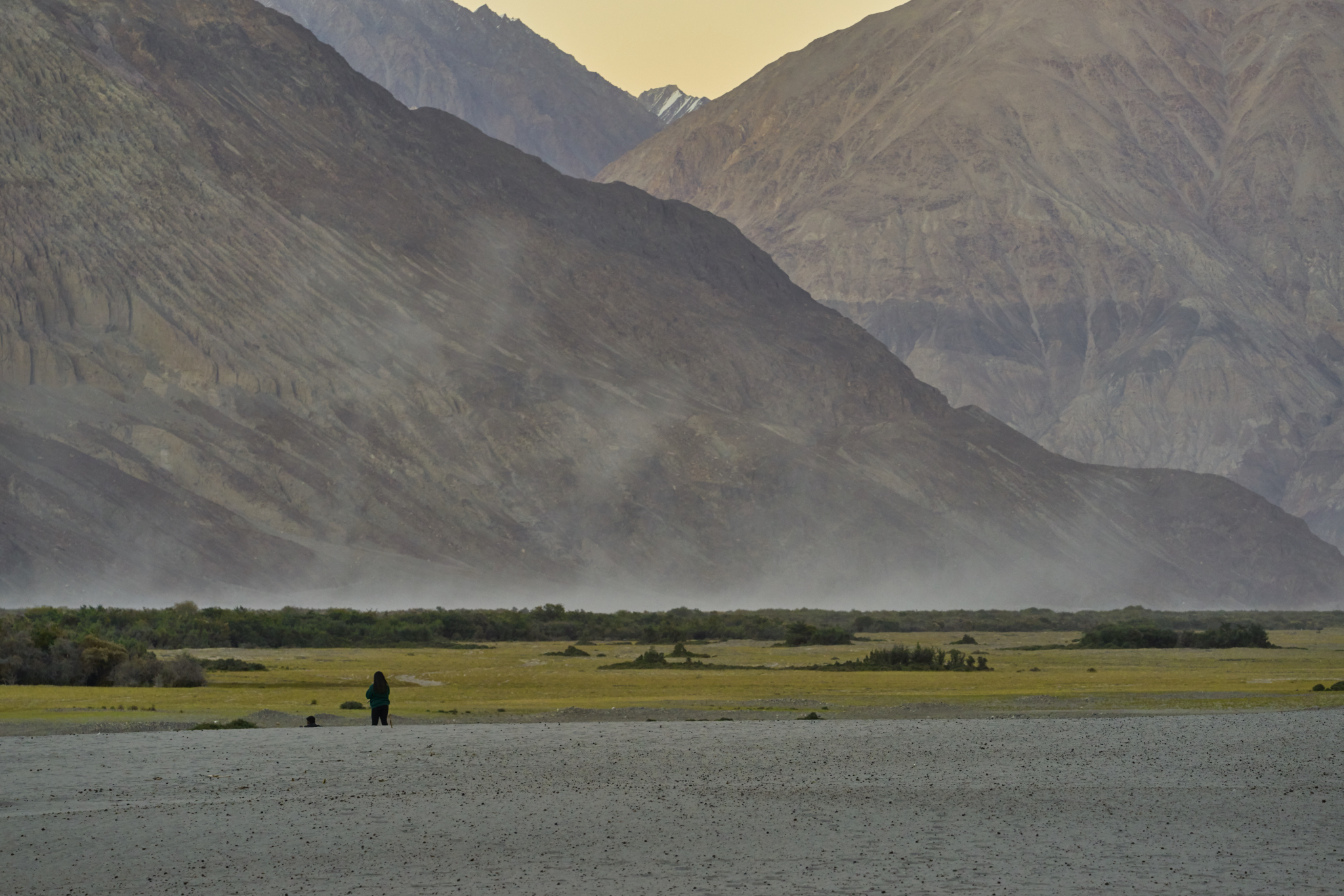
The person beside me didn’t know my history. No one needed to. I was just another figure on the gravel bar, camera in hand, waiting for light. But I was carrying something they couldn’t see: the accumulated knowledge of having weathered professional upheaval, relationships that fractured, social landscapes that shifted beneath my feet. I’d been broken in ways that taught me something, though I still couldn’t articulate what.
And then the actual storm arrived, and it felt like recognition.
The thickening came first. Air becoming dense, becoming hostile. The amber light that precedes erasure. I’d learned to recognize this feeling—not just in weather, but in life. The moment when you know something is ending and you can’t stop it. The moment when denial stops working and you have to simply stand in it.
The dust rose from the earth like it had been waiting for permission. It swept across the valley with purpose, erasing the green, then the trees, then the mountains that had seemed like they might organize meaning forever. And I watched them disappear and felt something I hadn’t expected: not panic, but a strange kind of steadiness.
I’ve lost things before. I know what loss looks like. I know that visibility always returns. I know that mountains don’t actually disappear—they just become temporarily invisible. And I know that standing in the storm is not the same as being defeated by it.
The person beside me was still. I was still. But my stillness was different now. It wasn’t the paralysis of someone who doesn’t know what’s coming. It was the deliberate quiet of someone who has learned that resistance only exhausts you faster.
The dust came closer. Fifty meters. Twenty. The world contracted to the immediate moment, to the single breath you can take, to the knowledge that you cannot see what’s next. And instead of fighting it, I let my shoulders drop. Instead of trying to hold steady, I let the wind move through me.
This is what the previous storms taught me: trying to brace against tempests only makes them hurt more. The work is not in holding on. The work is in letting go.
The dust entered my lungs and I didn’t fight it. My eyes watered and I let them water. The wind moved my hair into directions it had never been and I let it. This is what I’d gathered from the professional challenges that shaped how I work now. From the relationships that tested me and taught me what matters. From the social friction that showed me who I actually am. Each storm had taught me the same thing: you cannot control everything that moves through your life, but you can control how you move with it instead of against it.
And there is a strange kind of freedom in that surrender.
Not the freedom of escape. Not the freedom of transcendence. But the freedom that comes from finally, finally stopping the exhausting work of pretending you have more control than you do. When you stop fighting, you have energy for something else. Energy for breath. Energy for noticing. Energy for standing in the storm without needing it to justify itself.
The visibility collapsed completely. I was inside erasure now—fifty meters of world, then nothing. The person beside me became an abstraction, a shape, an idea of companionship in the fog. And I realized: I’ve done this before. I’ve stood in complete disorientation. I’ve faced moments where I couldn’t see the path forward. I’ve survived them.
Not intact. That’s important. I didn’t emerge from any of those storms unchanged. The person I was before the professional challenges is not the person standing here now. From the relationships that tested me reformed my understanding of what I need. The social friction forced me to clarify who I actually am, separate from what others expected. I’m not the same. I will never be the same again.
But I’m still here. And I know how to move through storms now.
This knowledge doesn’t make storms easier. But it changes how you stand in them. You stop asking “will I survive?” because you already know the answer. You’ve already done it. Multiple times. And then you’re left with a stranger question: does surviving mean I understand anything? Or am I just moving forward with the same confusion, only now I’m better at hiding it?
The dust kept moving. The wind kept ravaging. And I stood in it with the steadiness that only comes from having been ravaged before and learning that ravaging is not the same as destruction. Damage and destruction are not the same thing. You can be damaged and still be whole. You can be altered and still be yourself.
When the dust finally settled—gradually, the world slowly reconstructing itself—I looked at the mountains as they reappeared. They were unchanged. The valley was unchanged. The world barely registered the storm because from the world’s perspective, it was just weather. Just wind moving particles from one place to another. Just a moment in geological time that meant nothing to the mountains or the earth or the vast indifference of the universe.
But I had changed. Not because the storm was meaningful. But because I’d stood in it without needing it to be meaningful, and that’s a different kind of strength altogether.
The dust settled on my skin and in my hair and I didn’t brush it away immediately. I let it sit there for a moment. Evidence of having been somewhere. Proof of having stood in something and survived. And then I did brush it away, because that’s the next part of this. Not clinging to the storm as if it defined me. Not treating it as sacred because it was difficult. Just: dust off, and move on.
This is what I’ve learned from multiple storms, multiple breakings, multiple reconstructions: the courage isn’t in facing the tempest. Courage is overrated. The real work is in the after. In the willingness to dust yourself off and keep moving even when you’re not sure where you’re moving toward. In the ability to let go of what the storm changed because holding onto it serves no purpose. In the understanding that storms pass, you survive them, and then the world continues asking you to show up.
The person beside me was still there, equally altered and equally unmoved by whatever had just happened. We didn’t speak. There was no need. We’d both stood in erasure and come out the other side, which is all any of us ever do.
I carried the storm with me through the rest of the day. The dust in my lungs, the rawness in my throat, the knowledge that visibility had returned and would inevitably become opaque again at some point. And I held it all lightly, because I’ve learned to hold everything lightly now. The storms. The recoveries. The moments of clarity. The periods of confusion. None of it is meant to be clung to.
The real courage isn’t in the standing. It’s in the letting go afterward. It’s in the ability to say: this storm changed me, and I don’t fully understand how, and I’m moving forward anyway. It’s in the willingness to dust off the sand and continue toward whatever comes next, not because you’ve figured anything out, but because stopping is the only option you cannot live with.
The desert continues. The wind will return. And I will stand in it again because I know how to stand in it now. Not because I’m fearless. Not because I’ve transcended difficulty. But because I’ve been broken and rebuilt enough times to know that breaking and rebuilding are not the end of the story. They’re just the middle. And the work is to keep moving through the middle toward an ending you can’t yet see, trusting that your feet will find the ground beneath the dust.
I don’t know if this is wisdom or just the survival strategy that looks like wisdom from a distance. But I know this: I’ve walked through professional challenges and learned how to navigate them differently. I’ve loved and been tested and learned what I actually need. I’ve watched social landscapes shift and realized I could shift with them. I’ve stood in storms and felt the wind move through me without needing it to transform me.
And I will do it again. Not because I’m brave. But because the alternative is to stop moving, and I’ve learned that stopping is the only real defeat.
The dust settles. The world returns. And I am still here, ready for whatever storm comes next—not because I want it, but because I know how to face it.
That’s enough. That has to be enough.