I stood in the cold that gathers in low places.
Not cold the way you experience it elsewhere—this wasn’t a temperature that announces itself. It rose from the valley floor in the moment the sun touched the higher peaks, a cold that seemed to come not from air but from shadow itself, from all the hours of darkness waiting beneath the daylight. My hands knew it first. Then the back of my neck. Then something colder still—the realization that I was already losing the light I was still standing in.
The particular silence was what undid me. Not empty. Full of all the sound that hadn’t happened yet. The wind that would come in an hour. The night birds preparing their calls. The way the mountains would speak once humans stopped trying to listen. I could feel it gathering like the cold, and I understood that I had traveled through months of complications to arrive at a place where arrival no longer mattered. Only standing here. Only this standing, in this light, with the smell of dust and altitude and something older than both rising from the sand.
I raised the camera because I didn’t know what else to do with the panic.
The panic came first. Not the beauty. Not the longing. The sharp animal knowledge that this moment was already becoming memory while I was still living it. That the light burning on the highest peaks was already a thing I was losing. That somewhere in the space between raising the camera and pressing the shutter, the sun had moved imperceptibly closer to the edge, and I was one breath closer to darkness.
This is something I didn’t expect: that beauty would feel like threat.
The Moment After the Moment
When I lowered the camera, the light had already shifted. I hadn’t moved. Nothing around me had changed. But something fundamental had altered. The moment I tried to hold had become the moment I was losing. The present had become the past.
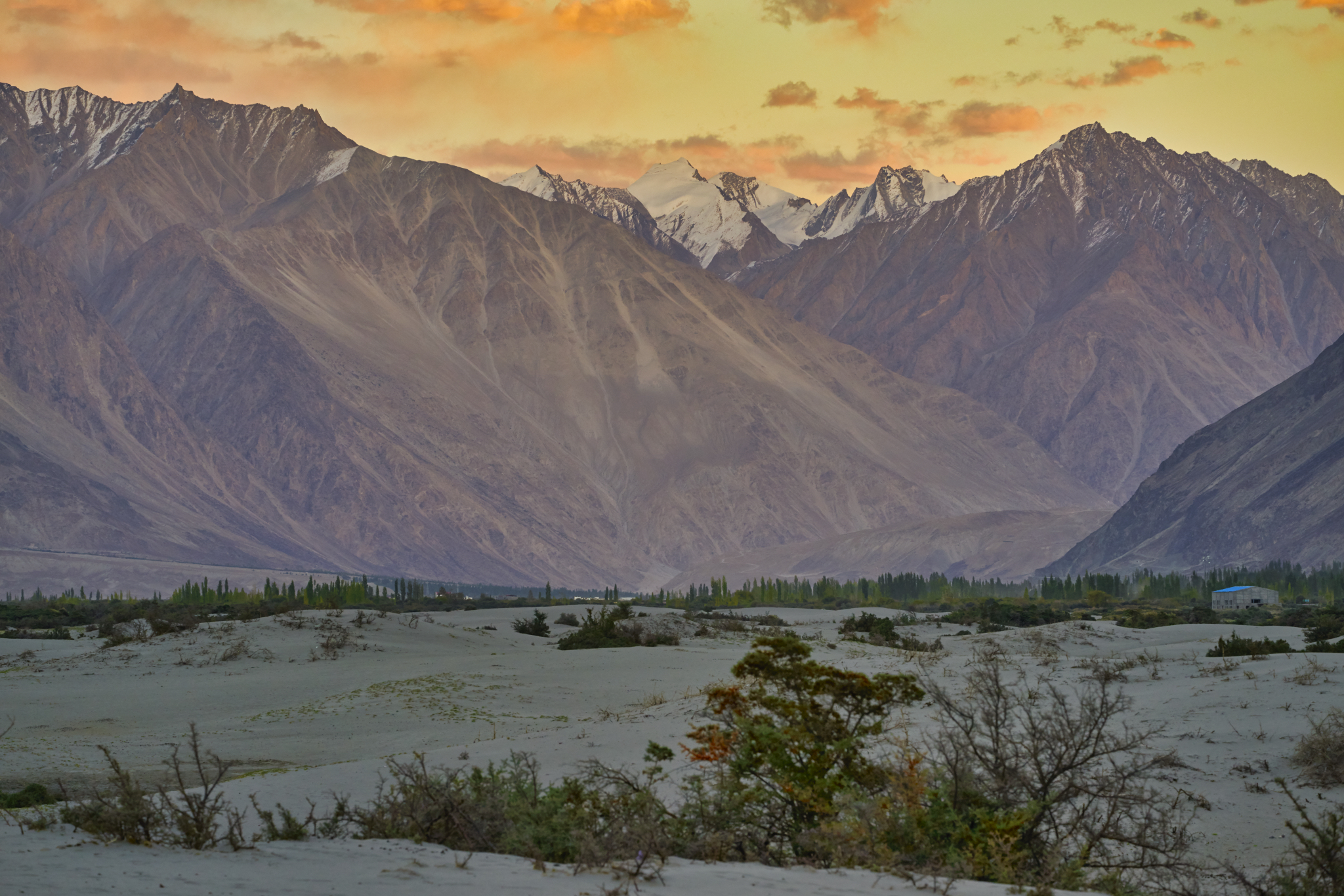
I watched the light climb the mountains from below, burning gold on the lower slopes, touching the middle reaches with rose, already surrendering the highest peaks to mauve. Each shift happened so gradually that I couldn’t point to the moment it occurred. The light withdrew the way tide goes out, the way breath leaves the body.
And I couldn’t tell if I was watching it leave or if it was watching me left behind.
The Multiplication of Selves
There were people visible across the valley floor—figures small enough that you cannot distinguish whether they’re moving or still. I realized that each of them was experiencing a different sunset than the one I was experiencing.
The person standing on the near edge still had light burning on their shoulders. But mine had already begun to abandon me. We were in the same valley, the same moment, but living in completely different temporal states. And somewhere far enough back, wrapped already in shadow, someone was watching both of us—the ones who still had light and the one beginning to understand what it meant to stand in the margins.
I tried to remember a time when I felt this way about a person. I could. But I’m not sure that’s the same thing as understanding it. They were already becoming memory and I was still standing in the place where the memory happened. We were in the same room but living in different times. They were moving forward into their life and I was already archiving what had just ended.
Is this what longing actually is? Not the ache of wanting someone present, but the specific pain of watching them move into a time you cannot follow?
The Photograph as Betrayal
I looked at the image I’d captured and felt almost nothing. I expected recognition. Instead I saw geometry. Light on stone. Accurate color rendering. The photograph had done its job—it had held the moment still. But the moment held still is no longer the moment at all.
What the photograph captured: the amber on the upper slopes, the rose in the middle reaches, the bruised mauve at the peaks. The green thread of the poplars. The people like punctuation in the vast sentence of the valley.
What it lost: the cold gathering in the low places. The way my shadow had disappeared so gradually that I couldn’t point to the moment it was gone. The knowledge that I was insignificant in exactly the way I needed to be. The dread that accompanied the beauty. The sense that I was being watched by this light—observed, assessed, found both important and completely unnecessary.
A photograph denies time. It claims a moment can be held. But the moment wasn’t what mattered. The leaving was what mattered. And you can’t photograph leaving.
I’ve been staring at this image for days, trying to recover the panic I felt standing there. But looking at it, I feel only distance. Memory has smoothed the panic into something acceptable—longing, beauty, philosophy. I feel like a liar.
Or like someone who needs the lie to survive it.
What Returns, What Doesn’t
I went back the next day. I told myself it was to photograph the sunset again, to capture what I’d missed. The real reason was simpler: I wanted to feel that panic again. That sharp knowledge that I was losing something in the moment I was still inside it.
But the clouds had come in overnight. The sun was there somewhere, diffused now, scattered. The light fell everywhere equally. No amber. No rose. No distinction. Just a kind of gray brightness that made everything visible and beautiful nothing.
I stood in that flat light and felt something close to terror. I stood there for maybe two minutes before I wanted to leave. My body was already turning away. I could feel it—the physical impulse to abandon the place, to stop witnessing, to go back and erase the previous day from my body’s memory. I wanted to leave so badly that for a moment I almost did.
And then I turned to go. In the turning I understood what was happening: I was abandoning not just the valley but the entire architecture of meaning I’d built on the previous day’s light. If the light could be like this—flat, teaching nothing—then maybe it had taught me nothing yesterday either. Maybe I’d constructed the teaching. Maybe I’d needed it so badly that I’d manufactured it out of gradient and shadow.
Because if the moment is contingent on precise atmospheric conditions and the angle of my own readiness, then I cannot trust anything. Not that I was transformed. Not that the panic was real. Not that any of it meant what I told myself it meant.
Maybe I just saw light hitting mountains and constructed meaning on top of it to give myself permission to feel something. Maybe there is no teaching here. Maybe there’s just human beings desperate enough to believe that beauty means something, and I am one of those desperate human beings.
The Uncertainty That Remains
I’m sitting with this now, and I don’t have resolution for it. I don’t know if I was actually transformed by the Nubra Valley sunset or if I simply witnessed light and told myself a story about longing. I don’t know if the panic I felt was the voice of truth or just anxiety dressed in poetic language. I don’t know if the people visible in the valley were actually experiencing different temporal states or if I projected that onto them because I needed the world to reflect back the fragmentation I felt inside myself.
I want to believe I was transformed. I want it so badly that I’ve spent days constructing these theories. Building cathedrals of meaning out of longing. Turning impermanence into something that feels like wisdom when really it might just be resignation wearing a poet’s mask.
What I know: the light was real. The cold was real. The silence was real. The mountains don’t care whether I was changed by them. They’ll be there tomorrow, pleated and ancient, speaking in geological time, utterly indifferent to the meaning I impose.
What I know: I cannot go back to that moment and experience it again. Not because the light is gone, but because I am not the same person who stood in it.
Maybe that’s the only honesty available to us—not that we are transformed by beauty, but that we are transformed by our own capacity to believe we can be. That the teaching isn’t in the moment but in what we do with the gap between the moment and memory. That love isn’t in the possession but in the willingness to stand in something that’s already leaving and call it sacred precisely because it’s leaving.
Or maybe I’m just rationalizing the fact that I cannot hold beauty and pretending the inability is actually the point. Maybe I want so badly to believe I was transformed that I’m constructing these entire theories to make the wanting feel like wisdom rather than desperation. I cannot tell the difference anymore between genuine insight and the beautiful lie I’ve told myself to survive the fact that the light left and I couldn’t keep it.
Both versions of myself feel equally real right now—the one who was changed and the one who wasn’t. Both are true. Neither can be trusted.
The valley continues. The light will return. And all of us will stand in that amber hour, cold gathering at our feet, knowing we’re already losing it, believing the loss means something, unable to prove that it does.
I don’t know if any of this is true. But I know I cannot stop believing it is.