There are moments when you realize light has been doing something to you the entire time, and you’ve only just noticed. Not in the mountain-top epiphany sense. More like the light has been burning away your certainties so gradually that you can’t remember what you were certain about.
I was standing in Nubra Valley as the sun began its leaving, and somewhere between the first moment I looked and the moment I raised the camera, I understood that I was no longer observing the light. I was being observed by it. Remade by it. There’s a difference between seeing golden hour and understanding that golden hour is seeing you.
What Happens in the Spaces Between
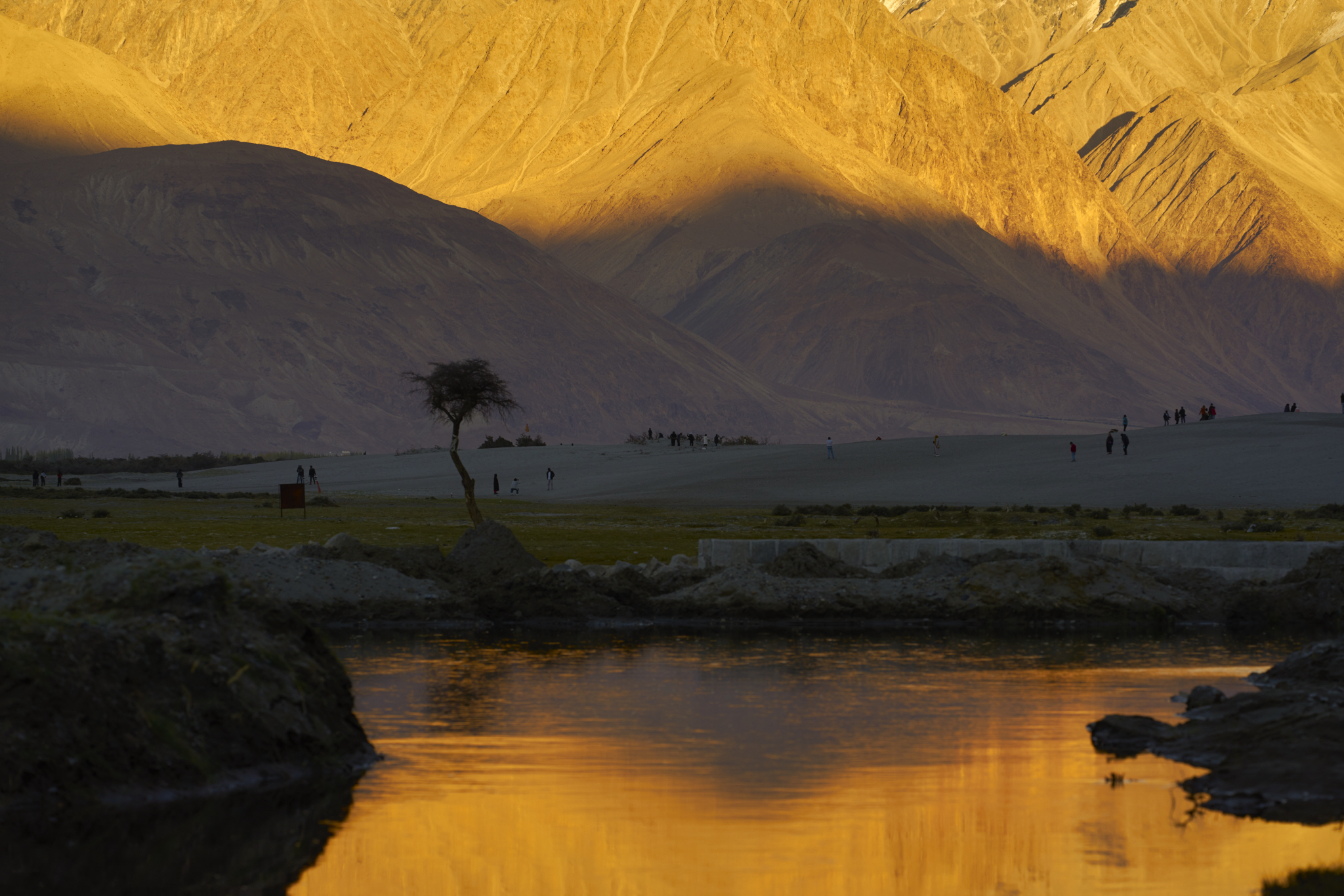
The photograph shows the valley floor suspended between states—that bruised amber where the sun still touches the upper mountains while the lower reaches have already surrendered to something closer to shadow. People scattered across that vast expanse like the landscape had briefly permitted them to exist there. The green thread of poplars holding on to water that shouldn’t be possible at this altitude. Everything caught in a moment of negotiation: between day and what comes after, between stone that will endure and light that won’t.
But here’s what the photograph cannot show, and what I’m only beginning to understand weeks later: I was being remade in those spaces between things. Not in the bright parts where light is obvious and announcing itself. In the spaces where two different times of day were touching.
Pico Iyer wrote once about how travel doesn’t move you through space so much as it rewires you. You think you’re going to a place and coming back the same person with memories attached. Instead you discover you’ve been fundamentally altered by exposure to something that doesn’t care whether you’ve been altered or not. The place simply continues being itself, and you continue being yourself, except you’re no longer yourself because you’ve been shaped by indifference.
Light works the same way. Especially at altitude. Especially in valleys where time moves slowly enough that you can feel it moving.
The Paradox of Fading Beauty
What I couldn’t have predicted is that the most transformative moments wouldn’t come from the brightest light—the perfect golden hour everyone comes for. They came from the moment just after. When the light was already leaving. When I had to choose between trying to capture what was there or surrendering to what was happening.
I chose to capture it. The shutter closed and opened like a breath I wasn’t aware I was holding.
But the real transformation happened in the seconds after. When I lowered the camera and the light had already shifted. When I realized I’d been so focused on fixing the moment that I’d missed the actual experience of it leaving. And in missing the leaving, I’d learned something that the bright perfect moments never teach you: that beauty is most itself when it’s abandoning you.
The mountains in that valley—pleated, ancient, speaking in geological time—they understand this. They don’t resist the fading light. They don’t try to hold on to the brightness. They simply accept each shift in illumination the way they accept the seasons, the way they accept that they’re being worn down grain by grain by wind. There’s a kind of grace in that acceptance that has nothing to do with resignation.
Kazuo Ishiguro writes about this—the way profound changes often occur not as events but as the slow recognition of something that’s been happening all along. You don’t feel yourself changing. You feel only the quiet aftermath of having been changed. The light doesn’t announce itself. It simply alters the angle of the world, and you’re left standing in a different place than the one you arrived in, though nothing has moved.
The Indifference That Shapes
Here is something I’ve been reluctant to admit: the valley didn’t care that I was there. The light fell on me with the same indifference it fell on the stone. It would have been equally golden, equally transformative, if I’d never arrived.
I used to think this should feel diminishing. The ego wants to believe that our witnessing matters. But standing in that valley, I felt something closer to relief. What if it doesn’t matter? What if I’m free precisely because I’m unnecessary?
The people visible in the photograph—small enough that you cannot distinguish whether they’re moving or still—they are being sculpted by light that has absolutely no investment in them. Their consciousness is being altered by beauty that will forget them the moment the sun moves. And somehow this is exactly what they needed.
This is what I needed. Though it took me a while to stop resenting it.
What the Camera Held and What It Lost
I have been trying to recover that moment by looking at the photograph. The golden mountains. The amber valley floor. That ribbon of impossible green. The distant figures holding their small places in vastness.
What the photograph held: the precise geometry of light on stone.
What it lost: the cold gathering in the low places. The particular silence—not empty but full of all the sound that hadn’t happened yet. The smell of dust and altitude and something older than both. The way my shadow had disappeared so gradually that I couldn’t point to the moment it was gone. The knowledge, arriving quietly and without announcement, that I had traveled through months of complications—airports, cities, the noise of wanting—to arrive at a place where arrival no longer mattered.
Only standing there mattered. Only the standing, in that light, with no arrival to finish, no destination to reach.
I remember thinking—or perhaps I only think now that I thought it then—that this is what pilgrimage actually means. Not the arriving. Not the reaching some holy place and proving you’ve been there. But the slow opening that happens when the world shows you that you’re insignificant in the kindest possible way.
What Happens When You Return
The next day I went back.
I told myself it was to photograph again, to get another angle, to capture what I’d missed. The real reason was simpler and more desperate: I wanted to feel that again. The light teaching me. The mountains speaking. The valley remaking me in that amber hour.
But the clouds had come in overnight. The sun was still there somewhere, but it was diffused now, scattered. The light fell everywhere equally, without distinction. No golden hour. No amber. No conversation between fading and enduring. Just a kind of gray brightness that made everything visible but beautiful nothing.
I stood in that flat light and felt something close to panic. This was the same valley. The same mountains. The same time of day, nearly. But the magic—and yes, I was calling it magic now, admitting how much I’d wanted to believe in it—the magic had not returned.
I understood then what I’d been refusing to understand the day before. That light is not a teacher you can return to. That the valley had not transformed me permanently into someone who could hold beauty and impermanence. I was the same uncertain person I’d always been. The light yesterday had been contingent. Accidental. Dependent on a precise arrangement of sun and atmosphere and my own readiness that could never be replicated.
The photographs from that second day show the valley clearly. Clearly and without revelation. I look at them now and I see nothing I didn’t already know.
What the clouds took was not just the light. They took my certainty that I’d been changed. They forced me to consider that maybe I hadn’t been transformed at all. Maybe I’d just been temporarily moved, the way anyone is moved by something beautiful, and I’d constructed an entire philosophy on top of that ordinary feeling to give it weight it didn’t possess.
This is harder to admit than the revelation. This is the part that isn’t poetic.
And yet—and this is what I’m still sitting with—I’m not sure I was wrong either. The light was real. The transformation, or whatever it was, was real. But it wasn’t permanent. It wasn’t transferable. It couldn’t be earned or learned or recovered. It was exactly what it appeared to be: a moment. And the moment’s power wasn’t diminished by being unrepeatable. If anything, the unrepeatability was the entire point.
I had wanted to be someone who could hold beauty. Instead I’ve become someone who can hold the knowledge that I cannot hold beauty. That it moves through me and moves on. That the person I was in that light is not the person I am in this gray day, and both of those people are equally real.
The Conversation That Continues
What I didn’t expect is that the light, even as it faded, even as I turned away and the moment became past, would continue working. Not in memory—memory is too static, too recoverable. But in the actual substance of how I think now. The way I hold contradictions. The way I understand that something can be temporary and also eternal, that beauty can be indifferent and also embracing, that I can matter and also not matter, both at the same time.
The mountains don’t remember me. I’ve accepted this. It’s even comforting. But I remember the mountains. I carry the light in a way I can’t quite articulate. I carry the moment of watching that light leave, which taught me something that the moment of receiving that light never could.
This asymmetry—bearing witness to something that will never acknowledge being witnessed—is the truest thing about being alive that I know.
When I look at the photograph now, I see what was there and feel almost nothing, which surprises me. I expected longing. Instead what I feel is stranger: a kind of completion. As if the photograph has finished its work.
But here’s what I’m only understanding now: I went back the next day hoping to feel it again. I stood in the same place at the same hour, and the clouds had come in. The light was flat. Diffused. Teaching nothing. And I realized that I had already begun the work of turning a moment into a memory, a memory into a lesson, a lesson into a philosophy that would save me from having to admit the simple truth: it was beautiful, and now it’s gone, and I can’t make it come back.
There’s something almost cruel in how much peace that brings me. But there’s also something lonely.
The mountains will forget. The light has already left. The sand shifts beneath different feet now. And I’m standing here, carrying something that refuses to stay still, that continues to change even in memory, even in the telling of it.
This is what I’ll carry forward: not the bright hour, but the moment just after. The understanding that light doesn’t need me to see it to be light. The valley doesn’t need me to witness it to be valley.
Some days I’m not sure whether I was transformed by the valley or whether I simply transformed the valley into something I needed it to be. That uncertainty—the fact that I can no longer trust my own memory of what happened to me—maybe that’s the real teaching. Not that light shapes consciousness. But that consciousness shapes light. And once you know that, you can never quite believe in either one the same way again.
The light will return tomorrow. It will be different. I will be different. We will find each other briefly in that difference, and I will never know whether I’ve been changed or whether I’m simply the kind of person who tells himself he’s been changed.
And I’ve made peace with not knowing.