I came out of the darkness carrying something I couldn’t name.
The Assembly Hall—the Dukhang—had been full of voices for an hour. Not singing exactly, though there was melody. Not speaking, though there were words. Something older than either: the Gelugpa monks welcoming sunrise with sounds that seemed to rise not from throats but from the valley floor itself, from all the centuries of prayer that had soaked into these walls and were now being called up again, breath by breath, syllable by syllable, into the morning air.
I had sat in that darkness—not total darkness, but the bruised pre-dawn where shapes are suggestions and nothing is certain—and felt my own breath slow to match theirs. Felt the restlessness I’d carried from city life drain away like water through sand. Felt something ancient and patient settle into the space where hurry used to live.
And then I stood and walked toward the doorway.
This is what I want to tell you about. Not the prayer itself—though the prayer was everything. Not the sunrise—though the sunrise burned gold on peaks that have watched empires dissolve. But this: the threshold. The exact moment of standing between the inner world where monks had been chanting sutras in the dark, and the outer world where Ladakh was assembling itself in light.
What Happens at the Edge of Two Worlds
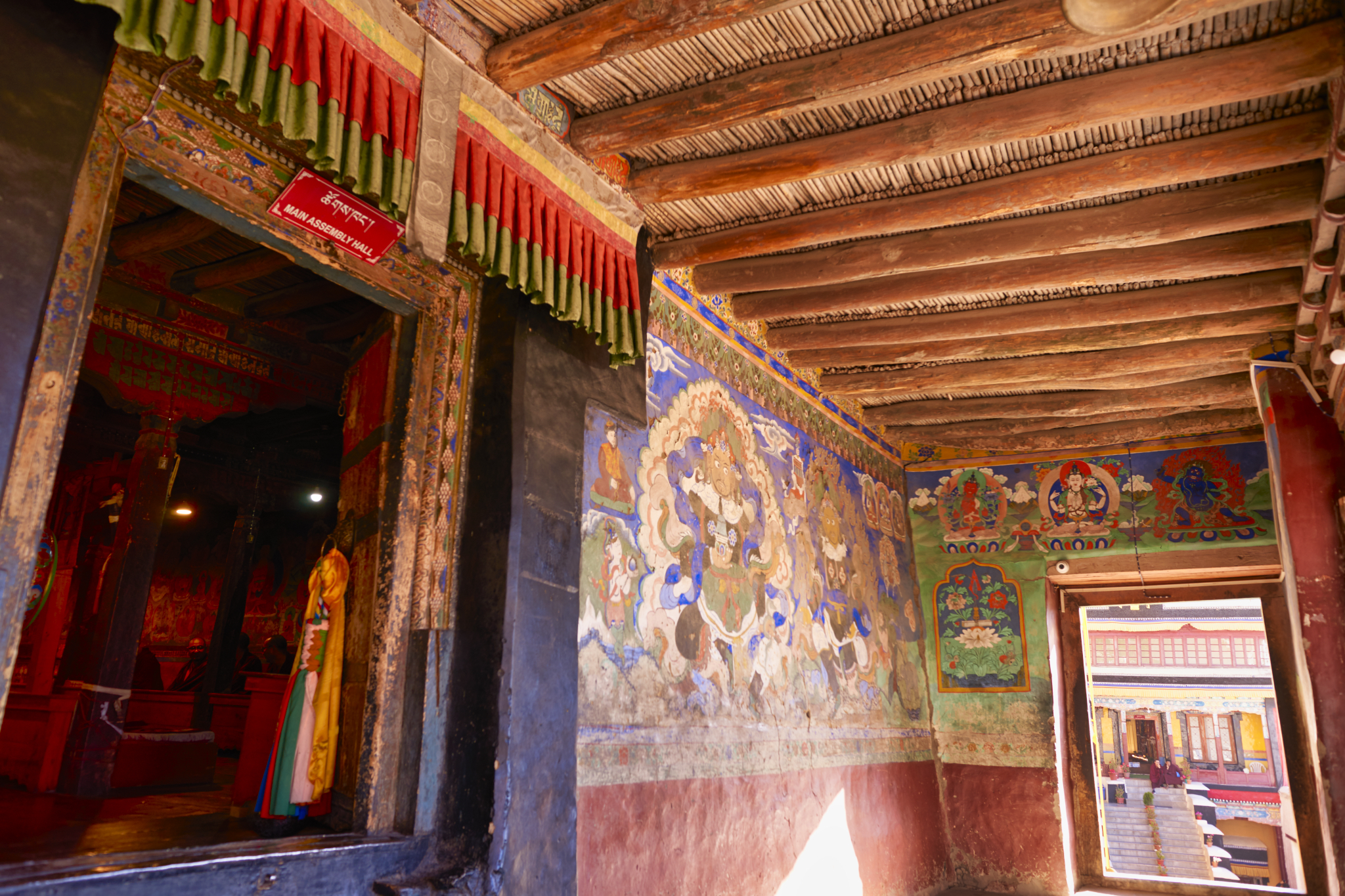
Look at the architecture of it—the way the wood is painted in bands of green and red and gold, the way the beams above show their age in splits and weathering, the way someone long ago decided that transition deserved ornament. That the movement from inner to outer, from darkness to light, from prayer to world, was sacred enough to frame.
I stood there longer than I intended. My body understood something my mind was still working through.
Inside: the low rumble of chanting, the smell of butter lamps and old wood, the presence of something—faith, maybe, or just the accumulated weight of attention paid over centuries. The feeling of being held by ritual, by repetition, by the knowledge that this has happened every morning for longer than anyone remembers and will happen tomorrow regardless of whether I am here to witness it.
Outside: Ladakh. The valley spreading below in that particular morning light that makes distance unclear. The mountains holding their snow like memory. That ribbon of impossible green—poplars or willows, something stubborn enough to insist on life at this altitude. The courtyard still in shadow but preparing for sun.
I was standing in both. This is what I couldn’t have predicted. That it would hold both worlds simultaneously, and in holding them, would suggest something about the possibility of being present to inner and outer at once.
The Architecture of Letting Go
What the photograph shows: faded murals on aging walls—bodhisattvas and deities whose features have been softened by time and weather. The wooden doorframe striped in ceremonial colors. The darkness of the interior giving way to brightness beyond.
What it cannot show: how my hands were still cold from the pre-dawn sitting. How the sound of the chanting had burrowed into my chest and was still vibrating there. How the act of walking toward light felt less like movement and more like being moved—as if the light itself was pulling me forward while something in the darkness was reluctant to let me go.
And this: the knowledge that I was leaving something behind that I could not take with me. That the person who sat in that darkness for an hour would not be the same person who walked out into the Ladakhi morning. But also the knowledge that transformation doesn’t happen all at once. That it happens in doorways, in the exact moment when you’re neither inside nor outside but both.
What the Monks Already Know
They do this every morning. They sit in the darkness before dawn and they call up the sun with their voices. They walk through this same doorway, and they carry the prayers out into the day, and then the day happens—ordinary, necessary, filled with all the small tasks that constitute a life—and then they return to the darkness and they begin again.
This is what I’ve been trying to understand since I left Thiksey. Not the prayers themselves—those belong to a tradition I can witness but never fully inhabit. But this: the daily practice of moving between inner and outer, between stillness and action, between the dark where transformation happens and the light where you have to live with having been transformed.
The monks don’t struggle with this the way I did. They don’t stand paralyzed wondering whether to hold on to what they experienced inside or release it to what’s waiting outside. They simply move. They carry the prayers with them the way they carry their breath. It’s not effort. It’s not philosophy. It’s just the rhythm of their days.
The Light That Waits
The sun was already on the peaks when I finally stepped through. Not dramatic sunrise—that had happened while I was still inside, still listening. But the aftermath of sunrise, when the light has settled into being light and the world has accepted being visible again.
The courtyard held its shadows in the low places. The prayer flags were already moving in the morning wind. Somewhere below, in the valley, people were beginning their days—waking, making tea, carrying water, all the ordinary tasks that constitute a life. The mountains watched with their ancient indifference. The air smelled of dust and cold and something I can only describe as possibility.
I stood there with the prayer still vibrating in my chest and the cold still in my hands and the knowledge that I would leave this place and return to airports and cities and all the complications of wanting. That the transformation—if transformation is even the right word—would not last in the way I wanted it to last. That memory would smooth the edges until even this moment would become just another photograph, just another story I tell about the time I went to Ladakh.
But here’s what I’m holding now, months later, looking at this image: I am still standing there in some fundamental way. Still balanced between the prayer and the world. Still learning what it means to carry darkness into light and light back into darkness.
The monks know this. They’ve always known this. They don’t divide their world into sacred and ordinary, into temple and valley, into prayer and work. They simply move through doorways. They simply breathe.
And that morning at Thiksey, I stood in their doorway and I understood—briefly, incompletely, in the way you understand anything that matters—that every moment is a threshold. That we are always standing between inner and outer, darkness and light, what we’ve released and what we’re about to become.