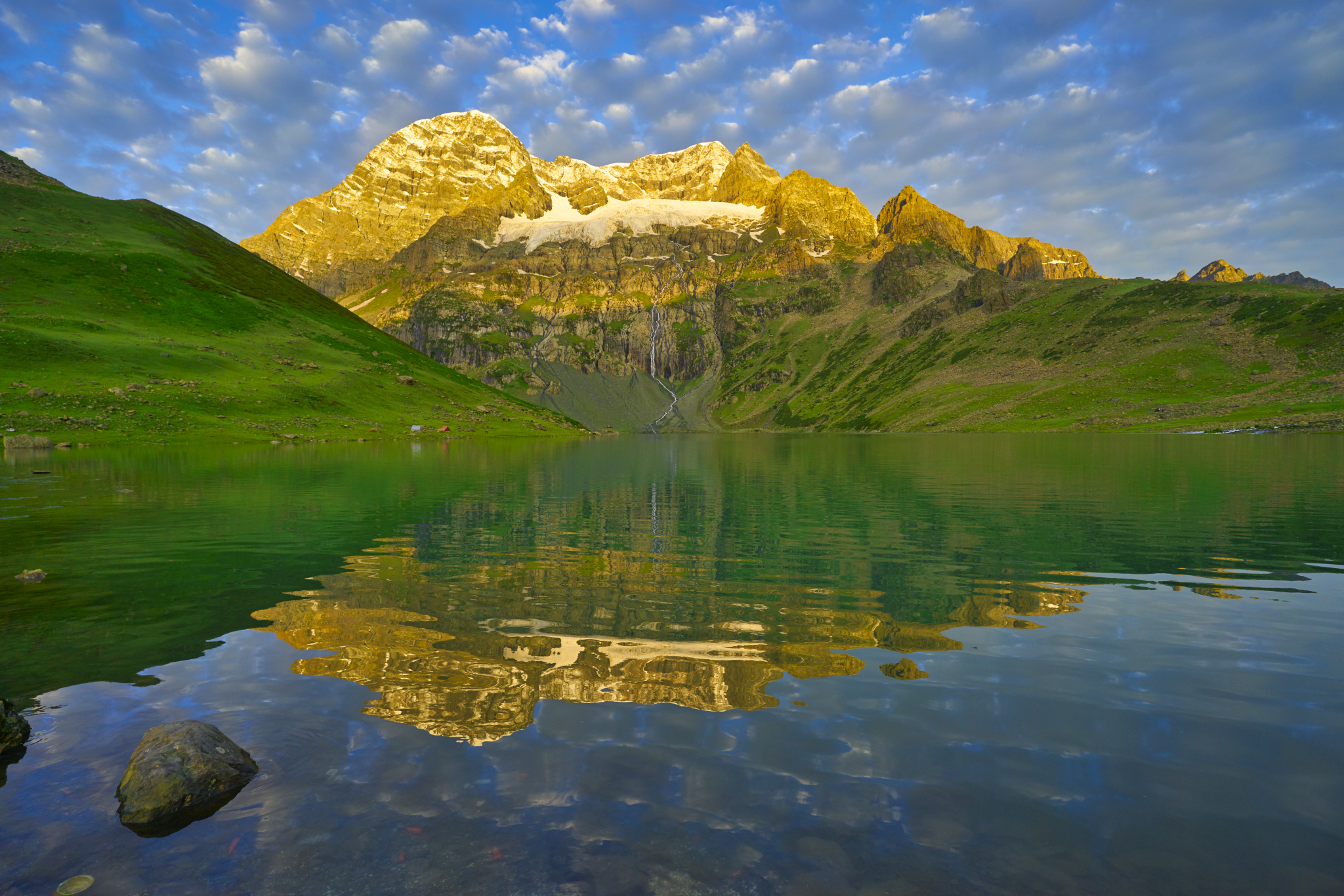
In the sanctuary of morning light, Mount Harmukh unveils itself like a slowly turning page in some ancient scripture written in stone and snow. The mountain wears its golden robe with the quiet dignity of a meditation master who has sat in silence for millennia, watching the small dramas of human seeking unfold in the valleys below.
Here, at the end of this pilgrimage through Kashmir’s liquid jewels, the lake becomes a mirror not just of peaks and sky, but of something more elusive—that trembling moment when the boundaries we carry so carefully begin to dissolve. The water holds the mountain so perfectly that earth and heaven seem to have forgotten their supposed separation, existing instead as one unbroken conversation between reflection and reality.
There is something about such moments—when light transforms stone into something approaching prayer—that makes our careful constructions of self seem suddenly fragile as morning mist. The ego, that persistent narrator of our separateness, falls quiet before such immensity. What remains is not the small, defended self we drag through our daily rounds, but something vast and unnamed that was always there, waiting beneath the surface of our busyness.
This is perhaps what mountains teach us, if we have walked far enough to listen: that the golden light falling across Harmukh’s face is the same light that illuminates our own. The stillness in the water is the stillness we carry within. The trek ends here, but the true journey—the one that leads us back to what we never really left—has only just begun.
In such moments, standing at the edge of this emerald mirror, we remember what every mystic has whispered and every mountain has known: we have always been the unity we seek.